
Frequently Asked Questions
Our collection of FAQs provides clear, fact-based answers to common questions about environmental testing, regulatory oversight, and Gore’s actions. We regularly update the information to ensure it reflects the latest data and developments.

General Questions & Background
What is PFOA/PFAS?
When people talk about PFAS in the context of water or the environment, they are often referring to specific compounds such as PFOA, PFOS, and four other PFAS compounds that are included in the EPA’s drinking water standards.
We’ve worked with our suppliers to eliminate PFOA from our supply chain and now only purchase fluoromaterials from vendors who certify they do not use PFOA.
Does/Did Gore manufacture PFOA?
No. Gore has never manufactured or processed PFOA (Perfluorooctanoic Acid). Trace amounts were historically present in certain raw materials supplied to Gore. As a result, trace levels of PFOA were historically present in the raw materials used by Gore.
Gore only purchases fluoromaterials from suppliers who certify they do not use PFOA, and all of Gore’s PTFE suppliers have signed on to the EPA PFOA Voluntary Stewardship Program.
What is Gore doing to address the PFOA found in residents’ water?
Gore is taking a science-based, community-first approach in coordination with the Maryland Department of the Environment (MDE). Our response includes:
- For residents within our sampling area: Bottled water and POET filtration systems at no cost, with long-term maintenance
- New sampling methods: Advanced PFOA sampling procedures across multiple facilities
- Sharing data findings: Submission of site-specific work plans and data to regulators
- Ongoing collaboration: Continued coordination with MDE
- Significant investment: Substantial resources committed to investigation and resident support
- Proposed Remediation: In 2026, while continuing the site investigation at the Cherry Hill facility, Gore has proposed remediation plans in the immediate vicinity of the facility.
What can you tell us about the lawsuits?
Gore denies the allegations in the lawsuits that have recently been filed. We remain committed to the health and safety of our Associates, the broader community, and the environment.
For decades, Gore has proactively enhanced workplace and environmental practices and worked with suppliers to eliminate PFOA from our supply chain many years ago.
We will continue to defend ourselves through the legal process, guided by facts and science.
Is Gore planning to put remedial measures in place?
In 2026, while continuing the site investigation at the facility, Gore has proposed remediation in the immediate vicinity of the Cherry Hill facility.
The primary approach to remediation will be a ‘pump and treat’ groundwater remediation technology, which uses extraction wells to capture the groundwater, treat it onsite, and discharge it after testing confirms it meets permitting criteria.
When is remediation at Cherry Hill expected to begin?
In June 2025, we submitted an Interim Remedial Action Plan to the Maryland Department of the Environment (MDE) outlining our proposed approach to remediate the presence of PFOA in groundwater in the immediate vicinity of our Cherry Hill facility. While site investigations continue in coordination with state regulators, Gore is poised to begin remediation activities at Cherry Hill in 2026.
More information about our remediation planning is available here: Addressing PFOA in Groundwater Near Gore’s Cecil County Facilities.
What does “pump and treat” mean? What happens to the treated water after remediation?
The primary approach to remediation will be a ‘pump and treat’ groundwater remediation technology, which captures groundwater, treats it onsite, and discharges it after testing confirms it meets permitting criteria. This proven method is designed to capture and contain the migration of PFOA in groundwater and reduce concentrations over time.
Before any treated water is discharged, it is tested to confirm it meets specific water quality criteria established in coordination with the Maryland Department of the Environment. Discharge requirements are reviewed and approved through the permitting process.
This work is part of Gore’s ongoing, data-driven approach to addressing PFOA impacts in groundwater near the Cherry Hill facility.
More information about the pump-and-treat system is available here: How Gore’s Pump-and-Treat System Works.
How will the community be kept informed as investigation work continues?
Gore is committed to ongoing communication with the community as work progresses. Updates on site investigation activities, remediation planning, and key milestones will continue to be shared on this site.
Is Gore providing water filtration systems or access to alternative water sources?
Yes. All residents identified in sampling areas submitted to MDE were offered bottled water.
Residents who participated in Gore’s water sampling plan were also offered either a POET water filtration system or, where available, a connection to the public water system at no cost.
How is Gore determining who is in the water sampling area?
Gore uses a stepwise, data-informed process based on plans submitted to and coordinated with MDE. Sampling areas were initially determined using on-site data and residential well testing results and expanded as new data became available.
Maps of sampling areas are available on facility pages:
Is Gore sampling the water from residents in the area?
Yes. Gore has conducted residential water sampling in coordination with MDE. Residents were contacted directly if their property fell within approved sampling areas.
Maps of current sampling areas are available on facility pages.
How can I find out if my house is in the water sampling area?
If your home is within a designated sampling zone, you should have received a letter from Gore or Arcadis. Maps are also available on individual facility pages. Additional questions can be directed through the Contact page.
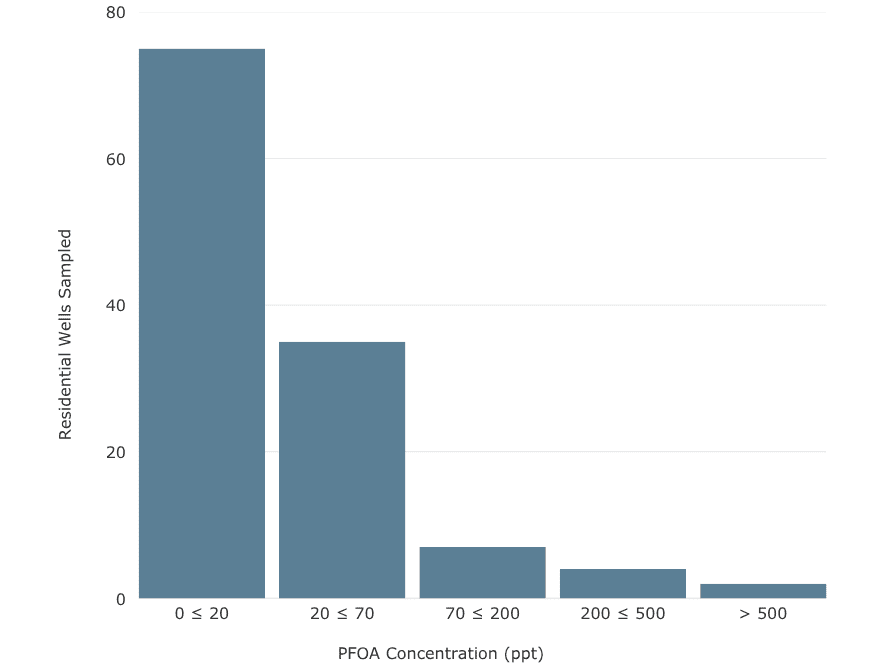
What are the results of Gore’s residential well sampling?
Gore began posting summary graphs of residential water sampling results in November 2024. These visuals are updated monthly to reflect the latest available data.
I have questions about the POET system installed in my home. Who do I contact?
If you have questions about the POET system, contact Arcadis directly using the hotline provided in your installation materials.
For more information, refer to EPA resources on drinking water and PFAS treatment technologies.
Additional Resources & Information
We recognize that trusted public agencies are the best source for broader PFAS information. Below are helpful resources and details on how Gore is supporting the community.
To residents within Gore’s sampling areas
Gore has offered residents free POET systems or connections to public water as part of its data-driven groundwater assessment.
Learn how the State of Maryland is tracking PFAS in your area
Visit the Maryland Department of the Environment’s PFAS Resource Center.
Understand the health impacts of PFAS from the CDC
Refer to the CDC’s PFAS fact sheet for health impact information.
Check current drinking water criteria for PFAS
See the EPA’s PFAS resource hub for regulations and guidance.
See if your home is in a sampling zone
Review facility pages for Fair Hill, Cherry Hill, Appleton, and Elk Mills to determine inclusion and next steps.
